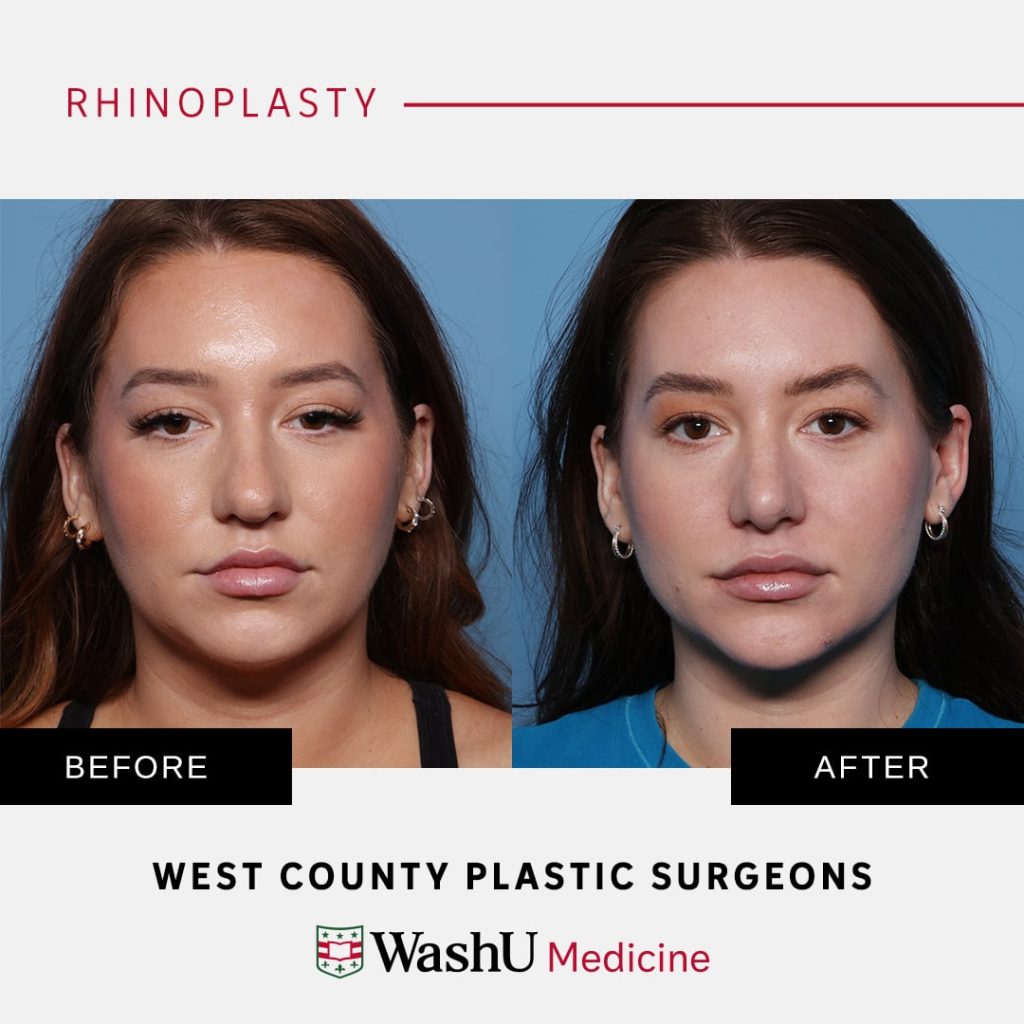
You’ve likely heard of rhinoplasty, but for a lot of patients, the goal isn’t really “making the nose smaller.” It’s about facial balance. West County Plastic Surgeons, customizes a rhinoplasty procedure to your own facial structure and goals, whether your nose feels too prominent, too petite, uneven, or simply doesn’t match the rest of your profile. Because the nose itself isn’t the only feature that matters, we will start a nose reshaping consultation with a careful look at the whole picture, including the position of your chin and upper jaw affects how the nose is perceived.
Rhinoplasty can touch up any or all areas of the nose: from the dorsum or bridge of the nose to the nasal tip. Which of those areas needs attention, and how much, depends entirely on what’s bothering you and what your anatomy allows. Whatever the goal, West County Plastic Surgeons approaches every rhinoplasty with natural-looking results in mind, refining what’s already there rather than creating a look that feels out of place on your face.
Choosing a Technique
Not every rhinoplasty looks the same on the inside. If you’re after subtle refinement and want to skip anesthesia and downtime altogether, injectable fillers can camouflage small irregularities, with results lasting one to two years.
For surgical rhinoplasty, your surgeon may use an open approach, a small incision on the columella (the strip of skin and tissue between the nostrils) and incisions inside the nostrils that gives full visibility for more detailed reshaping, or a closed approach that relies on incisions hidden inside the nose. Depending on what you need, the procedure might involve removing or repositioning tissue or reinforcing the structure with cartilage grafts taken from the septum, the ear, or a rib. Some patients are also candidates for preservation rhinoplasty depending on your goals.
None of these approaches is “better” across the board. The right one comes down to your anatomy and your goals, which your surgeon will walk through with you at a consultation.
What Recovery Looks Like
Rhinoplasty is performed under general anesthesia and typically takes one to five hours. Most patients return to work within two weeks, but should hold off on anything vigorous, especially activities that could injure the face, for four to six weeks. A splint on the inside or outside of the nose is common for about a week. Visible bruising usually clears within two to three weeks and swelling within a couple of months after that, but subtler swelling, particularly around the tip, can linger for several months to a year while your results continue to settle.
Rhinoplasty and Breathing: More Connected Than You’d Think
Rhinoplasty and septoplasty often get confused for the same procedure, but they have different goals. Rhinoplasty reshapes the nose for cosmetic reasons, like refining the bridge, tip, or nostrils. Septoplasty corrects a deviated septum, the wall between your two nasal passages, to improve airflow and breathing. The two are frequently done together, since a septum that’s off-center can also make breathing harder, and enlarged turbinates (the structures inside the nose that filter and humidify air) can be corrected at the same time if they’re contributing to the problem. When it’s medically necessary, the functional portion of a combined procedure may be covered by insurance.
Procedures Often Paired With Rhinoplasty
Because the nose doesn’t exist in isolation, some patients combine their procedure with others for a more complete result:
Chin augmentation: A receded chin can make the nose look more prominent by comparison, so building out the chin and adding facial implants can bring the whole profile into better balance.
Cartilage grafts: For some revision cases or more significant structural work, grafts from the septum, ear, or rib add long-term reinforcement.
BOTOX® for “bunny lines”: The same neuromodulator used for frown lines can also relax the crinkling that shows up on the bridge and sides of the nose when it wrinkles.
Facial fillers: Restoring volume in the cheeks, temples, lips, or jawline helps the surrounding face support your new profile. Blepharoplasty: Eyelid surgery addresses drooping or puffiness that can undercut an otherwise refreshed look.
Frequently Asked Questions About Rhinoplasty
Yes, through a technique called alar base reduction, where small wedges of tissue are removed at the base of the nostrils and the skin is carefully closed to keep things looking proportional.
Yes. Whether it’s from genetics or an old injury, reshaping the cartilage, adding grafts, or repositioning the nasal bones (osteotomies) can restore symmetry.
It will, but the intent is harmony rather than transformation. Refining the nose tends to bring the eyes, lips, and chin into better proportion with each other. Friends are more likely to notice you look more balanced or refreshed than to identify exactly what changed.
No. That’s typically a sinus, allergy, or infection issue, not a structural one, so an ENT is the right specialist for that concern!
Is Rhinoplasty right for me?
If you have been thinking about how your nose fits with the rest of your face, or you’re dealing with both a cosmetic concern and a breathing issue, it’s worth bringing up at a consultation. Our team can help you understand what’s realistic for your anatomy, and how the procedure fits into your broader goals.
Ready to learn more about rhinoplasty in St. Louis? Contact West County Plastic Surgeons by calling 314.996.8800 or reaching out online to get started.
If you have questions or would like to book a consultation with one of the surgeons at West County Plastic Surgeons of WashU Medicine, please call (314) 996-8800.